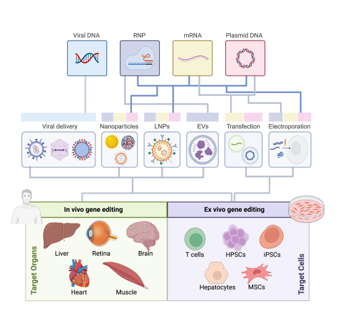

The current efforts of the Laboratory of Gene Editing for Rare Diseases focus on:
- Developing CRISPR-based gene-editing platforms to correct mutations underlying genetic diseases, including immunodeficiencies, metabolic disorders affecting the central and peripheral nervous systems, and solid tumours. Platforms include CRISPR-Cas, base, prime and epigenome editing.
- Creating advanced delivery systems capable of efficiently transporting genome-editing tools to target tissues—such as blood, bone marrow, CNS, and PNS—after systemic administration.
- Establishing combinatorial strategies to enhance the quality and engraftment potential of genome-edited hematopoietic stem cells.
- Characterizing stem-cell behaviour and complex tissue barriers (such as the blood–brain barrier and blood–nerve barrier) to improve therapeutic efficacy. To achieve these goals, the lab employs a broad range of molecular and cellular biology techniques, including molecular cloning, cell manipulation, imaging, phenotypic characterization, omics approaches, 3D in vitro models (organoids), and animal models.